FEATURE ARTICLE REDESIGN

Rich storytelling.
Built from a
shared system.

Bringing the craft of bespoke feature articles into the hands of more journalists and editors.

The Palace of Culture and Science amid Warsaw’s modern skyline.A story sets the direction.
A SYSTEM MAKES ROOM FOR IT

Images. Reporting.
Data. A different rhythm.

Warsaw photography: Alik Keplicz / AP, File. Pattern illustration from the article atlas.
THE CHALLENGE

Design is a limited resource.

THE APPROACH

Research the patterns. Build a shared vocabulary.

THE OPPORTUNITY

Put editorial expression into the CMS.

THE OPPORTUNITY

More stories deserve this level of care.

Design capacity is limited. A reusable CMS component system can give more journalists and editors the tools to build compelling, ad-free features with strong imagery and purposeful interaction.

RESEARCH BEFORE RECIPES

Find the patterns
behind the one-offs.

We examined a broad range of feature articles: standard editorial builds, development-led experiences and award samples. The aim was to identify the recurring pieces that make a feature article work.

EDITORIAL FEATURES

The everyday building blocks

Reading columns, images, captions, data, headings and supporting material.

Reference: Poland

BESPOKE EXPERIENCES

The more immersive patterns

Scroll-led geography, staged introductions and narrative transitions.

Reference: Adrift

AWARD SAMPLES

The details worth carrying forward

Patterns for emphasis, explanation and a distinctive reading rhythm.

Reference: Prison to Plate

We catalogued the units and the transitions between them: how a story opens, moves through its evidence and finds its ending.

THE ARTICLE PATTERN ATLAS

A vocabulary for
building a feature.

The research became a catalog of reusable patterns: 45 core module variants, alongside immersive findings and composition flows. Every entry connects a schematic to the source that informed it.

Supplied sampleAward sampleImmersive comparison
Open original atlas

Image layouts · 6 catalog entries

Side-by-side pair

590px + 590px · separate captions

Media & embeds · 18 catalog entries

Photo carousel

M03

Slide count, arrows and fullscreen

Mixed-media carousel

M04

Video opens a multi-item gallery

More media & embeds patterns

Static comparison

M07

Three labels baked into one image

Grouped column chart

M08

AP graphic with note and source

Bar chart

M09

Two instances; one module variant

Annotated reconstruction

M16

Static composition; not a live 3D viewer

Text · 5 catalog entries

Bold paragraph label

C03

Looks like a heading; remains a paragraph

Supporting content · 12 catalog entries

Series promotional card

R02

Linked series title + description

Newsletter sign-up

R04

Email field, action and consent

Donation appeal

R05

In-story appeal and donation link

More supporting content patterns

Funding disclosure

R07

Support and independence statement

Production credits

R10

Dedicated digital presentation credits

Project identity banner

R11

Standalone Tracked image; no teaser or action

Immersive · 10 catalog entries

Staged introduction

I01

Full-screen text before the story title

Scroll-led globe

I02

Geography with narrative overlays

Sticky image sequence

I03

Scroll changes scenes and title overlays

Evidence-object grid

I04

Individual objects receive emphasis

Family-photo collage

I05

Multiple images, collective caption

Chapter progress

I06

Ten section links and progress segments

More immersive patterns

Map + timeline scrollytelling

I08

Scroll changes time cursor and chart scale

Transitions · 15 catalog entries

Opening → body

Dark lead area → light reading column

Text → wide media → text

Reading width expands, then contracts

Text → pair → text

One reading column becomes two images

Text ↔ floated image

Copy wraps around a smaller visual

More transitions patterns

Scroll → image crossfade

One staged scene changes to another

Scroll → geographic explanation

Map persists as narrative advances

Scroll → chart time / scale

Timeline advances with narrative

New findings · 6 catalog entries

Map + timeline scrollytelling

I08

Persistent geography + changing chart time / scale

Answer → survey results

I09

Selection reveals distribution and highlights your choice

FROM CATALOG TO CMS

Give editors
more choice.

Editors select, fill and arrange reusable CMS components. The system keeps typography, spacing and responsive behavior consistent.

Choose the pattern

Select a reading section, image layout, data graphic or immersive moment.

Add the reporting

Bring the text, media, captions, credits and sources into a defined component.

Compose the experience

Arrange the sequence and adjust the emphasis to suit the story.

THE SAME REPORTING, DIFFERENT COMPOSITIONS

One story.
Two different rhythms.

Scroll inside the article pages. Open a preview for a closer look.

POLAND · VARIATION 1

A photo-led feature

World news  Europe  Poland  Business  Economy
Warsaw skyline with the Palace of Culture and Science

WORLD NEWS

Poland is now among the world’s 20 largest economies. How it happened

POLAND / ECONOMYRead the story ↓
Warsaw · May 25, 2018 · Alik Keplicz / AP, File
Leer en español ↗

POZNAN, Poland (AP): A generation ago, Poland rationed sugar and flour while its citizens were paid one-tenth what West Germans earned. Today, the economy of the country has edged past Switzerland to become the world’s 20th largest with more than $1 trillion in annual output.

It’s a historic leap from the post-Communist ruins of 1989-90 to European growth champion, which economists say has lessons on how to bring prosperity to ordinary people, and that the Trump administration says should be recognized by Poland’s presence at a summit of the Group of 20 leading economies later this year.

The transformation is reflected in people like Joanna Kowalska, an engineer from Poznan, a city of around 500,000 people midway between Berlin and Warsaw. She returned home after five years in the U.S.

Polish GDP per capita, 1990–2025Polish GDP per capita rose from just 38% of the EU average to 85% of the EU averagePolandEuropean Union20,00040,000$60,000 per capita19902025Note: GDP measured in current international dollars, adjusted for purchasing power parity (PPP) to accountfor differences in the cost of goods and services across countries.Source: International Monetary Fund / Graphic: Will Jarrett

“I get asked often if I’m missing something by coming back to Poland, and, to be honest, I feel it’s the other way around,” Kowalska said. “We are ahead of the United States in so many areas.”

Kowalska works at the Poznan Supercomputing and Networking Center, which is developing the first artificial intelligence factory in Poland and integrating it with a quantum computer, one of 10 on the continent financed by a European Union program.

Kowalska worked for Microsoft in the U.S. after graduating from the Poznan University of Technology, in a job she saw as a “dream come true.”

But she missed having a “sense of mission,” she said.

“Especially when it comes to artificial intelligence, the technology started developing so rapidly in Poland,” Kowalska said. “So it was very tempting to come back.”

Breaking out of poverty

The guest invitation to the G20 summit is mostly symbolic. No guest country has been promoted to full member since the original G20 met at the finance minister level in 1999, and that would take a consensus decision of all the members. Moreover, the original countries were chosen not just by gross domestic product rank, but by their “systemic significance” in the global economy.

But the gesture reflects a statistical truth: In 35 years, a little less than one person’s working lifetime, Poland’s per capita GDP rose to $55,340 in 2025, or 85% of the EU average. That’s up from $6,730 in 1990, or 38% of the EU average and now roughly equal to Japan’s $52,039, according to International Monetary Fund figures measured in today’s dollars and adjusted for Poland’s lower cost of living.

Top 20 countries by GDP, 2025 (trillions USD)USA$30.62China$19.4Germany$5.01Japan$4.28India$4.13UK$3.96France$3.36Italy$2.54Russia$2.54Canada$2.28Brazil$2.26Spain$1.89Mexico$1.86South Korea$1.86Australia$1.83Turkey$1.57Indonesia$1.44Netherlands$1.32Saudi Arabia$1.27Poland$1.04Note: GDP measured in current international dollars, adjusted for purchasing power parity (PPP) to accountfor differences in the cost of goods and services across countries.Source: International Monetary Fund / Graphic: Will Jarrett

Poland’s economy has grown an average 3.8% a year since joining the EU in 2004, easily beating the European average of 1.8%.

It wasn’t simply one factor that helped Poland break out of the poverty trap, says Marcin Piątkowski of Warsaw’s Kozminski University and author of a book on the country’s economic rise.

One of the most important factors was rapidly building a strong institutional framework for business, he said. That included independent courts, an anti-monopoly agency to ensure fair competition, and strong regulation to keep troubled banks from choking off credit.

As a result, the economy wasn’t hijacked by corrupt practices and oligarchs, as happened elsewhere in the post-Communist world.

Poland also benefited from billions of euros in EU aid, both before and after it joined the bloc in 2004 and gained access to its huge single market.

Above all, there was the broad consensus, from across the political spectrum, that Poland’s long-term goal was joining the EU.

“Poles knew where they were going,” Piątkowski said. “Poland downloaded the institutions and the rules of the game, and even some cultural norms that the West spent 500 years developing.”

GDP per capita growth in post-communist countries, 1990–2024Poland has outpaced the growth of its neighborsPoland+252%Romania+148%Slovakia+130%Lithuania+129%Bulgaria+129%Estonia+115%Latvia+115%Slovenia+92%Hungary+91%Croatia+83%Czechia+72%Note: GDP measured in current international dollars, adjusted for purchasing power parity (PPP) to accountfor differences in the cost of goods and services across countries.Source: World Bank / Graphic: Will Jarrett

As oppressive as it was, communism contributed by breaking down old social barriers and opening higher education to factory and farmworkers who had no chance before. A post-Communist boom in higher education means half of young people now have degrees.

“Young Poles are, for instance, better educated than young Germans,” Piatkowski said, but earn half what Germans do. That’s “an unbeatable combination” for attracting investors, he said.

Success of an electric bus company

Solaris, a company founded in 1996 in Poznan by Krzysztof Olszewski, is one of the leading manufacturers of electric buses in Europe with a market share of around 15%. Its story shows one hallmark of Poland’s success: entrepreneurship, or the willingness to take risks and build something new.

Electric-bus production at the Solaris factory.
Poznan · January 29, 2026
Pietro De Cristofaro / AP

Educated as an engineer under the Communist government, Olszewski opened a car repair shop where he used spare parts from West Germany to fix Polish cars. While most enterprises were nationalized, authorities gave permission to small-scale private workshops like his to operate, according to Katarzyna Szarzec, an economist at the Poznan University of Economics and Business.

“These were enclaves of private entrepreneurship,” she said.

In 1996, Olszewski opened a subsidiary of the German bus company Neoplan and started producing for the Polish market.

“Poland’s entry to the EU in 2004 gave us credibility and access to a vast, open European market with the free movement of goods, services and people,” said Mateusz Figaszewski, responsible for institutional relations.

Then came a risky decision to start producing electric buses in 2011, a time when few in Europe were experimenting with the technology. Figaszewski said larger companies in the West had more to lose if switching to electric vehicles didn’t work out.

“It became an opportunity to achieve technological leadership ahead of the market,” he said.

An aging population

Challenges still remain for Poland. Due to a low birth rate and an aging society, fewer workers will be able to support retirees. Average wages are lower than the EU average. While small and medium enterprises flourish, few have become global brands.

Poznan Mayor Jacek Jaśkowiak sees domestic innovation as a third wave in Poland’s postsocialist economic development. In the first wave, foreign countries opened factories in Poland in the early 1990s, taking advantage of a skilled local population.

Shipyard workers in Gdansk.
Gdansk · August 23, 2007
Czarek Sokolowski / AP, File
A queue outside a Warsaw bakery.
Warsaw · August 23, 1989
David Caulkin / AP, File

Around the turn of the millennium, he said, Western companies brought more advanced branches, including finance, information technology and engineering.

“Now it’s the time to start such sophisticated activities here,” Jaśkowiak says, adding that one of his main priorities is investing in universities.

“There is still much to do when it comes to innovation and technological progress,” added Szarzec, the Poznan economist. “But we keep climbing up on that ladder of added value. We’re no longer just a supplier of spare parts.”

Szarzec’s students say more needs to be done to reduce urban-rural inequalities, make housing affordable and support young people starting families. They say Poles need to acknowledge that immigrants, such as the millions of Ukrainians who fled Russia’s full-scale invasion in 2022, contribute to economic development in an aging population.

“Poland has such a dynamic economy, with so many opportunities for development, that of course I am staying,” said Kazimierz Falak, 27, one of Szarzec’s graduate students. “Poland is promising.”

Equipment at the Poznan Supercomputing and Networking Center.
Poznan · January 28, 2026
Pietro De Cristofaro / AP

David McHugh reported from Frankfurt, Germany.
Scroll to exploreBack to top

Photography establishes place and scale. Data arrives as evidence within the reading journey.

Wide imageNarrative proseData graphics
Open original article

POLAND · VARIATION 2

A data-led feature

World news  Europe  Poland  Business  Economy
WORLD NEWS

Poland is now among the world’s 20 largest economies. How it happened

THE DATA
Polish GDP per capita, 1990–2025Polish GDP per capita rose from just 38% of the EU average to 85% of the EU averagePolandEuropean Union20,00040,000$60,000 per capita19902025Note: GDP measured in current international dollars, adjusted for purchasing power parity (PPP) to accountfor differences in the cost of goods and services across countries.Source: International Monetary Fund / Graphic: Will Jarrett

POZNAN, Poland (AP): A generation ago, Poland rationed sugar and flour while its citizens were paid one-tenth what West Germans earned. Today, the economy of the country has edged past Switzerland to become the world’s 20th largest with more than $1 trillion in annual output.

It’s a historic leap from the post-Communist ruins of 1989-90 to European growth champion, which economists say has lessons on how to bring prosperity to ordinary people, and that the Trump administration says should be recognized by Poland’s presence at a summit of the Group of 20 leading economies later this year.

The transformation is reflected in people like Joanna Kowalska, an engineer from Poznan, a city of around 500,000 people midway between Berlin and Warsaw. She returned home after five years in the U.S.

The Palace of Culture and Science amid Warsaw’s modern skyline.
Warsaw · May 25, 2018
Alik Keplicz / AP, File

“I get asked often if I’m missing something by coming back to Poland, and, to be honest, I feel it’s the other way around,” Kowalska said. “We are ahead of the United States in so many areas.”

Kowalska works at the Poznan Supercomputing and Networking Center, which is developing the first artificial intelligence factory in Poland and integrating it with a quantum computer, one of 10 on the continent financed by a European Union program.

Equipment at the Poznan Supercomputing and Networking Center.
Poznan · January 28, 2026
Pietro De Cristofaro / AP

Kowalska worked for Microsoft in the U.S. after graduating from the Poznan University of Technology, in a job she saw as a “dream come true.”

But she missed having a “sense of mission,” she said.

“Especially when it comes to artificial intelligence, the technology started developing so rapidly in Poland,” Kowalska said. “So it was very tempting to come back.”

Breaking out of poverty

The guest invitation to the G20 summit is mostly symbolic. No guest country has been promoted to full member since the original G20 met at the finance minister level in 1999, and that would take a consensus decision of all the members. Moreover, the original countries were chosen not just by gross domestic product rank, but by their “systemic significance” in the global economy.

But the gesture reflects a statistical truth: In 35 years, a little less than one person’s working lifetime, Poland’s per capita GDP rose to $55,340 in 2025, or 85% of the EU average. That’s up from $6,730 in 1990, or 38% of the EU average and now roughly equal to Japan’s $52,039, according to International Monetary Fund figures measured in today’s dollars and adjusted for Poland’s lower cost of living.

THE DATA
Top 20 countries by GDP, 2025 (trillions USD)USA$30.62China$19.4Germany$5.01Japan$4.28India$4.13UK$3.96France$3.36Italy$2.54Russia$2.54Canada$2.28Brazil$2.26Spain$1.89Mexico$1.86South Korea$1.86Australia$1.83Turkey$1.57Indonesia$1.44Netherlands$1.32Saudi Arabia$1.27Poland$1.04Note: GDP measured in current international dollars, adjusted for purchasing power parity (PPP) to accountfor differences in the cost of goods and services across countries.Source: International Monetary Fund / Graphic: Will Jarrett

Poland’s economy has grown an average 3.8% a year since joining the EU in 2004, easily beating the European average of 1.8%.

It wasn’t simply one factor that helped Poland break out of the poverty trap, says Marcin Piątkowski of Warsaw’s Kozminski University and author of a book on the country’s economic rise.

One of the most important factors was rapidly building a strong institutional framework for business, he said. That included independent courts, an anti-monopoly agency to ensure fair competition, and strong regulation to keep troubled banks from choking off credit.

As a result, the economy wasn’t hijacked by corrupt practices and oligarchs, as happened elsewhere in the post-Communist world.

Shipyard workers in Gdansk.
Gdansk · August 23, 2007
Czarek Sokolowski / AP, File
A queue outside a Warsaw bakery.
Warsaw · August 23, 1989
David Caulkin / AP, File

Poland also benefited from billions of euros in EU aid, both before and after it joined the bloc in 2004 and gained access to its huge single market.

Above all, there was the broad consensus, from across the political spectrum, that Poland’s long-term goal was joining the EU.

“Poles knew where they were going,” Piątkowski said. “Poland downloaded the institutions and the rules of the game, and even some cultural norms that the West spent 500 years developing.”

THE DATA
GDP per capita growth in post-communist countries, 1990–2024Poland has outpaced the growth of its neighborsPoland+252%Romania+148%Slovakia+130%Lithuania+129%Bulgaria+129%Estonia+115%Latvia+115%Slovenia+92%Hungary+91%Croatia+83%Czechia+72%Note: GDP measured in current international dollars, adjusted for purchasing power parity (PPP) to accountfor differences in the cost of goods and services across countries.Source: World Bank / Graphic: Will Jarrett

As oppressive as it was, communism contributed by breaking down old social barriers and opening higher education to factory and farmworkers who had no chance before. A post-Communist boom in higher education means half of young people now have degrees.

“Young Poles are, for instance, better educated than young Germans,” Piatkowski said, but earn half what Germans do. That’s “an unbeatable combination” for attracting investors, he said.

Electric-bus production at the Solaris factory.

Success of an electric bus company

Electric-bus production at the Solaris factory.
Poznan · January 29, 2026
Pietro De Cristofaro / AP

Solaris, a company founded in 1996 in Poznan by Krzysztof Olszewski, is one of the leading manufacturers of electric buses in Europe with a market share of around 15%. Its story shows one hallmark of Poland’s success: entrepreneurship, or the willingness to take risks and build something new.

Educated as an engineer under the Communist government, Olszewski opened a car repair shop where he used spare parts from West Germany to fix Polish cars. While most enterprises were nationalized, authorities gave permission to small-scale private workshops like his to operate, according to Katarzyna Szarzec, an economist at the Poznan University of Economics and Business.

“These were enclaves of private entrepreneurship,” she said.

In 1996, Olszewski opened a subsidiary of the German bus company Neoplan and started producing for the Polish market.

“Poland’s entry to the EU in 2004 gave us credibility and access to a vast, open European market with the free movement of goods, services and people,” said Mateusz Figaszewski, responsible for institutional relations.

Then came a risky decision to start producing electric buses in 2011, a time when few in Europe were experimenting with the technology. Figaszewski said larger companies in the West had more to lose if switching to electric vehicles didn’t work out.

“It became an opportunity to achieve technological leadership ahead of the market,” he said.

An aging population

Challenges still remain for Poland. Due to a low birth rate and an aging society, fewer workers will be able to support retirees. Average wages are lower than the EU average. While small and medium enterprises flourish, few have become global brands.

Poznan Mayor Jacek Jaśkowiak sees domestic innovation as a third wave in Poland’s postsocialist economic development. In the first wave, foreign countries opened factories in Poland in the early 1990s, taking advantage of a skilled local population.

Around the turn of the millennium, he said, Western companies brought more advanced branches, including finance, information technology and engineering.

“Now it’s the time to start such sophisticated activities here,” Jaśkowiak says, adding that one of his main priorities is investing in universities.

“There is still much to do when it comes to innovation and technological progress,” added Szarzec, the Poznan economist. “But we keep climbing up on that ladder of added value. We’re no longer just a supplier of spare parts.”

Szarzec’s students say more needs to be done to reduce urban-rural inequalities, make housing affordable and support young people starting families. They say Poles need to acknowledge that immigrants, such as the millions of Ukrainians who fled Russia’s full-scale invasion in 2022, contribute to economic development in an aging population.

“Poland has such a dynamic economy, with so many opportunities for development, that of course I am staying,” said Kazimierz Falak, 27, one of Szarzec’s graduate students. “Poland is promising.”

David McHugh reported from Frankfurt, Germany.

Original article at AP News ↗
Scroll to exploreBack to top

The economic change leads. Images, a pull quote and visual breaks create a different pace.

Data-led openingPull quotePhoto pair
Open original article

FROM PATTERN TO ARTICLE

The atlas,
in practice.

See all 15 editorial sections and media units beside their matching atlas schematic, pattern ID and explanation.

The schematics show the pattern. The article shows it in use.

MISSISSIPPI · ANNOTATED EDITION

The article beside the atlas

Election article · atlas alignment for every sectionView clean article
2026 Elections  Results  AP Vote Poll  Politics  Mississippi
Article opening
Mississippi Democratic Senate candidate Scott Colom gestures at an election event in Jackson, Miss., Wednesday, Nov. 11, 2026.
2026 ELECTIONS

Mississippi elects Democrat Scott Colom as state’s first Black US senator since Reconstruction

Mississippi Democratic Senate candidate Scott Colom gestures at an election event in Jackson, Miss., Wednesday, Nov. 11, 2026.Ellen Schmidt / AP
Narrative passage

JACKSON, Miss. (AP): Democratic nominee Scott Colom defeated Republican Sen. Cindy Hyde-Smith on Wednesday in Mississippi’s closely contested U.S. Senate race after a prolonged ballot counting process, giving the state its first Black U.S. senator since post-Civil War Reconstruction.

Colom’s narrow victory is a seismic shift in Mississippi, which has been controlled mostly by white conservatives for generations despite having the largest share of Black residents of any U.S. state. The outcome adds to a decisive midterm rebuke of President Donald Trump, whose party suffered defeats in several Republican-controlled states, and it will bolster some Democrats’ argument that their future runs through the American South.

“All I did was have the courage to imagine a night like this,” Colom told a crowd of hundreds who gathered at Tougaloo College for his victory party. “I had the courage to believe in Mississippi. I had the courage to understand that we can show the country that Mississippi matters.”

The Associated Press called the race in Colom’s favor after local officials spent several days processing absentee and provisional ballots, called affidavit ballots in Mississippi.

Scroll-led geography
THE RESULTS

Mississippi · U.S. Senate

99% of votes counted

Scott Colom wins.
AP race call: November 11, 2026, at 5:58 p.m.

Mississippi Senate results, November 17, 2026
CandidateVotesPct.
Scott Colom DEM480,15349.4%
Cindy Hyde-Smith* GOP472,12248.5%
Ty Pinkins IND20,4692.1%

* Incumbent
AP results snapshot · November 17, 2026, 12:41 p.m.

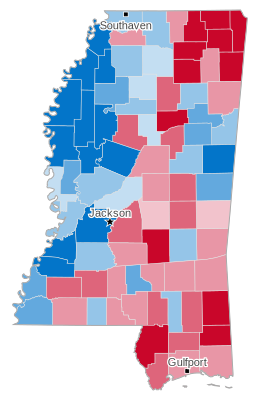
Mississippi county results map, captured from AP’s County leader view on November 17, 2026.
County leader · darker shades show a larger vote share.● Colom● Hyde-Smith
Explore the interactive county results
Narrative passage

The last time Mississippi chose a new Democratic senator was 1947; the winner was a staunch segregationist. Colom, a 43-year-old local prosecutor, capitalized on the state’s large Black population, discontent with the economy and Hyde-Smith’s missteps as she sought a second full term.

“They actually deserve a senator that will listen to them, that actually cares about what they think, actually cares about what they’re going through,” Colom said in the campaign’s closing stretch.

Hyde-Smith, 67, called Colom late Wednesday afternoon to concede and released a concession speech online shortly afterward.

“While this is not the outcome we worked for or hoped for, I respect the decision of Mississippi voters,” Hyde-Smith said. “I want to congratulate Scott Colom and wish him well as he takes on the tremendous responsibility of representing our great state.”

Colom said during the campaign that he could represent all of Mississippi, a state where racial divisions have long defined its politics and society, and he repeated that pledge after his victory.

“My commitment to you, each and every one of you, is that first I’m going to treat your children like I want my children to be treated,” Colom said. “I’m going to treat your parents the way I want my parents to be treated. I’m gonna treat your future the way I want my future to be” and “work to make every Mississippian’s life better.”

Video reporting
WATCH THE REPORTING
Democrat Scott Colom has won election to the U.S. Senate representing Mississippi, defeating Republican incumbent Cindy Hyde-Smith. Colom will be Mississippi’s first Black senator since the post-Civil War Reconstruction era. The race was called by The Associated Press on Wednesday. (AP video by Bill Barrow. Produced by Diego Medrano.)
Democrat supporters ecstatic after Scott Colom causes major upset in Mississippi
Democratic nominee Scott Colom defeated Republican Sen. Cindy Hyde-Smith in Mississippi’s closely contested U.S. Senate race on Wednesday after a prolonged ballot counting process. In his victory speech at Tougaloo College, Colom said, “I had the courage to understand that we could show the country that Mississippi matters.”
National Democrats, activists and Mississippians celebrate

National Democrats, activists and Mississippians celebrate

Party leaders hailed the senator-elect’s triumph, with nods to the South’s emerging status as a political battleground after other victories from North Carolina and South Carolina to Georgia and Texas.

“Scott ran the campaign of a lifetime and re-imagined what’s possible for Democrats in the South,” Democratic Senate leader Chuck Schumer of New York posted online.

Former President Bill Clinton, a native Arkansan who campaigned with Colom days before the election, addressed the senator-elect on social media, saying he won “because you believe in the promise of your state’s people. And they believed in you right back.”

Vera Finley was among those supporters.

“I am here to celebrate my parents and my grandparents. I am not one generation out of the cotton fields,” Finley said ahead of Colom’s victory speech. “Both of my parents picked cotton. And my great-grandmother was sold here as a slave from Virginia to here. So I am so excited to be on this side of history.”

Another Mississippian, NAACP President Derrick Johnson, issued a statement saying the state’s voters, most notably Black voters, “made history because they refused to be intimidated, discouraged, or counted out” in a state that has seen “some of the nation’s most difficult battles for voting rights.”

Photo pair
People use their phones as they attend an election event for Mississippi Democratic U.S. Senate candidate Scott Colom at Tougaloo College in Jackson, Miss., Wednesday, Nov. 11, 2026.
People use their phones as they attend an election event for Mississippi Democratic U.S. Senate candidate Scott Colom at Tougaloo College in Jackson, Miss., Wednesday, Nov. 11, 2026.Ellen Schmidt / AP
An attendee reacts during an election event for Mississippi Democratic U.S. Senate candidate Scott Colom at Tougaloo College in Jackson, Miss., Wednesday, Nov. 11, 2026.
An attendee reacts during an election event for Mississippi Democratic U.S. Senate candidate Scott Colom at Tougaloo College in Jackson, Miss., Wednesday, Nov. 11, 2026.Ellen Schmidt / AP
A race Washington once viewed as a long shot

A race Washington once viewed as a long shot

The contest was a latecomer to the national spotlight, finally drawing attention and money months after Black senators, including Georgia’s Raphael Warnock and Maryland’s Angela Alsobrooks, first urged donors and party leaders to see it as winnable.

The son of a onetime Republican who worked for President Ronald Reagan, Colom produced one of the year’s most widely circulated ads. After Hyde-Smith seemed to brush off high beef prices by saying consumers could choose other proteins, Colom cut a 30-second spot depicting incredulous voters saying they’d “pick another senator instead.”

When Trump came to Corinth, Mississippi, in late October to rally with Hyde-Smith, Colom walked the line of Trump supporters as they waited to enter. He introduced himself and asked about their concerns.

Later, when Trump called Hyde-Smith to the stage, she said only nine words in six seconds before stepping away: “Is this not the best president in our lifetime?”

Colom’s appearance outside the rally tracked his strategy of criticizing Trump’s policies, especially the Iran war that drove up gas prices and tariffs that caused headaches for Mississippi farmers, without taking personal jabs at the president or people who voted for him. Instead, he consistently put the onus on Hyde-Smith, framing her as a nonentity in Washington, a critique that resonated in a state accustomed to long-serving, powerful senators.

There is some irony in Hyde-Smith losing to Colom. In 2022, President Joe Biden nominated Colom to be a U.S. District Court judge. Mississippi’s senior Republican Sen. Roger Wicker and former Gov. Haley Barbour, who is also a former national Republican chairman, backed the nomination.

Hyde-Smith, however, blocked Colom’s confirmation. Colom said his campaign was never about getting even with Hyde-Smith.

Wide photograph
Mississippi Democratic Senate candidate Scott Colom talks on the phone at his campaign office in Jackson, Miss., Wednesday, Nov. 11, 2026.
Mississippi Democratic Senate candidate Scott Colom talks on the phone at his campaign office in Jackson, Miss., Wednesday, Nov. 11, 2026.Ellen Schmidt / AP
Colom called on Mississippi’s history

Colom called on Mississippi’s history

The senator-elect concluded his campaign with an ad that featured him at the Jackson home of Medgar Evers, the civil rights leader who, in 1963, was gunned down in his driveway by a white supremacist.

Colom told the story of Evers’ military service at Normandy in World War II, his voter registration efforts in Mississippi, his assassination and the three decades it took to win a conviction. “He was killed for helping Mississippians vote,” Colom said. “On Tuesday, use your vote and honor everyone who died for that right.”

At the lectern Wednesday night, Colom said it was appropriate that the race be called on Veterans Day, as he again paid tribute to Evers.

“He served his country, came home to Mississippi, and they wouldn’t let him vote,” Colom said. “But he had faith that Mississippi could make progress.”

Pull quote
Despite Republicans’ domination, the path was always there

Despite Republicans’ domination, the path was always there

Because of the Black population and its alignment with Democrats, Mississippi’s general elections have been closer for years than its Southern neighbors. Trump won by double digits in each of his three presidential contests, but in 2023, Republican Gov. Tate Reeves managed to win reelection by a margin of just 3 percentage points.

Colom and other Black party leaders and strategists insisted throughout 2026 that he could narrow the gap with strong Black turnout, Republican discontent and an uptick in Democrats’ usual share of the white vote in Mississippi.

Results showed strong turnout in the Mississippi Delta and its concentration of majority Black counties. But nearly all of the state moved leftward from the 2024 election, when Trump carried Mississippi by nearly 23 points.

Wide photograph
Mississippi Democratic Senate candidate Scott Colom, his wife Nadia Colom, and daughter's Gwendolyn Lucille Colom and Brooklyn Madison Colom, attend an election event in Jackson, Miss., Wednesday, Nov. 11, 2026.
Mississippi Democratic Senate candidate Scott Colom, his wife Nadia Colom, and daughter's Gwendolyn Lucille Colom and Brooklyn Madison Colom, attend an election event in Jackson, Miss., Wednesday, Nov. 11, 2026.Ellen Schmidt / AP
Narrative passage

Hyde-Smith was appointed to the Senate in 2018. She won a special election runoff in 2018 and a full term in 2020. Both times she defeated Democrat Mike Espy, a former U.S. agriculture secretary who’d also been Mississippi’s first Black congressman since Reconstruction.

During the extended vote count, Colom acknowledged the historic nature of his candidacy but said he cares more about what it means for others.

“My job is to do well enough as the next United States senator that the next time some young Black boy or girl has the work ethic, the vision and the values,” he said, “and they want to be United States senator, that nobody says because of anything I’ve done that they shouldn’t get a chance.”

Reporting credit

Barrow reported from Atlanta and Washington.

Scroll inside this article
15 sections mapped to their patternsBack to top

Another example.

EDUCATION · MISSING STUDENTS

A comparison-led feature

Education  Pandemic recovery  The Pandemic’s Missing Students
Rousmery Negrón and her son at home in Springfield, Massachusetts
EDUCATION

Millions of kids are missing weeks of school as attendance tanks across the US

Jessica Hill / AP

SPRINGFIELD, Mass. – When in-person school resumed after pandemic closures, Rousmery Negrón and her 11-year-old son both noticed a change: School seemed less welcoming.

Parents were no longer allowed in the building without appointments, she said, and punishments were more severe. Everyone seemed less tolerant, more angry. Negrón's son told her he overheard a teacher mocking his learning disabilities, calling him an ugly name

Her son didn’t want to go to school anymore. And she didn’t feel he was safe there.

He would end up missing more than five months of sixth grade.

Share of students chronically absent
15%Before the pandemic
More than 25%2021–22 school year

Source: AP reporting · August 2023

Across the country, students have been absent at record rates since schools reopened during the pandemic. More than a quarter of students missed at least 10% of the 2021-22 school year, making them chronically absent, according to the most recent data available. Before the pandemic, only 15% of students missed that much school.

All told, an estimated 6.5 million additional students became chronically absent, according to the data, which was compiled by Stanford University education professor Thomas Dee in partnership with The Associated Press. Taken together, the data from 40 states and Washington, D.C., provides the most comprehensive accounting of absenteeism nationwide. Absences were more prevalent among Latino, Black and low-income students, according to Dee’s analysis.

The absences come on top of time students missed during school closures and pandemic disruptions. They cost crucial classroom time as schools work to recover from massive learning setbacks.

Absent students miss out not only on instruction but also on all the other things schools provide, meals, counseling, socialization. In the end, students who are chronically absent, missing 18 or more days a year, in most places, are at higher risk of not learning to read and eventually dropping out.

“The long-term consequences of disengaging from school are devastating. And the pandemic has absolutely made things worse and for more students,” said Hedy Chang, executive director of Attendance Works, a nonprofit addressing chronic absenteeism.

“The long-term consequences of disengaging from school are devastating.”

Hedy Chang

In seven states, the rate of chronically absent kids doubled for the 2021-22 school year, from 2018-19, before the pandemic. Absences worsened in every state with available data, notably, the analysis found growth in chronic absenteeism did not correlate strongly with state COVID rates.

Kids are staying home for myriad reasons, finances, housing instability, illness, transportation issues, school staffing shortages, anxiety, depression, bullying and generally feeling unwelcome at school.

And the effects of online learning linger: School relationships have frayed, and after months at home, many parents and students don't see the point of regular attendance.

“For almost two years, we told families that school can look different and that schoolwork could be accomplished in times outside of the traditional 8-to-3 day. Families got used to that,” said Elmer Roldan, of Communities in Schools of Los Angeles, which helps schools follow up with absent students.

An empty elementary school classroom in the Bronx, New York
Brittainy Newman, File / AP

When classrooms closed in March 2020, Negrón in some ways felt relieved her two sons were home in Springfield. Since the 2012 shooting at Sandy Hook Elementary School in Connecticut, Negrón, who grew up in Puerto Rico, had become convinced mainland American schools were dangerous.

A year after in-person instruction resumed, she said, staff placed her son in a class for students with disabilities, citing hyperactive and distracted behavior. He felt unwelcome and unsafe. Now, it seemed to Negrón, there was danger inside school, too.

“He needs to learn,” said Negrón, a single mom who works as a cook at another school. “He’s very intelligent. But I’m not going to waste my time, my money on uniforms, for him to go to a school where he’s just going to fail.”

Millions are missing school

In Massachusetts, where Negrόn lives, the rate of chronically absent kids has more than doubled since before the pandemic. Other key states:

ATTENDANCE · BEFORE AND AFTER

How did attendance change?

Select a state to compare chronic absenteeism before and after pandemic school closures.

Massachusetts

2018–1913%
2021–2228%

Massachusetts: 13% to 28%, an increase of 15 percentage points.

Alaska

2018–1929%
2021–2249%

Alaska: 29% to 49%, an increase of 20 percentage points.

District of Columbia

2018–1930%
2021–2248%

District of Columbia: 30% to 48%, an increase of 18 percentage points.

California

2018–1912%
2021–2230%

California: 12% to 30%, an increase of 18 percentage points.

New York

2018–1919%
2021–2233%

New York: 19% to 33%, an increase of 14 percentage points.

Source: AP reporting · 2023

For people who've long studied chronic absenteeism, the post-COVID era feels different. Some of the things that prevent students from getting to school are consistent, illness, economic distress, but “something has changed,” said Todd Langager, who helps San Diego County schools address absenteeism. He sees students who already felt unseen, or without a caring adult at school, feel further disconnected.

Alaska led in absenteeism, with 48.6% of students missing significant amounts of school. Alaska Native students’ rate was higher, 56.5%.

Those students face poverty and a lack of mental health services, as well as a school calendar that isn’t aligned to traditional hunting and fishing activities, said Heather Powell, a teacher and Alaska Native. Many students are raised by grandparents who remember the government forcing Native children into boarding schools.

“Our families aren’t valuing education because it isn’t something that’s ever valued us,” Powell said.

“Our families aren’t valuing education because it isn’t something that’s ever valued us,”

Heather Powell

In New York, Marisa Kosek said son James lost the relationships fostered at his school, and with them, his desire to attend class altogether. James, 12, has autism and struggled first with online learning and then with a hybrid model. During absences, he'd see his teachers in the neighborhood. They encouraged him to return, and he did.

But when he moved to middle school in another neighborhood, he didn’t know anyone. He lost interest and missed more than 100 days of sixth grade. The next year, his mom pushed for him to repeat the grade, and he missed all but five days.

His mother, a high school teacher, enlisted help: relatives, therapists, New York’s crisis unit. But James just wanted to stay home. He's anxious because he knows he's behind, and he's lost his stamina.

“Being around people all day in school and trying to act ‘normal’ is tiring,” said Kosek. She's more hopeful now that James has been accepted to a private residential school that specializes in students with autism.

Juan Ballina and his mother Carmen near their home in San Diego
Gregory Bull / AP

Some students had chronic absences because of medical and staffing issues. Juan Ballina, 17, has epilepsy; a trained staff member must be nearby to administer medication in case of a seizure. But post-COVID-19, many school nurses retired or sought better pay in hospitals, exacerbating a nationwide shortage.

Last year, Juan's nurse was on medical leave. His school couldn’t find a substitute. He missed more than 90 days at his Chula Vista, California, high school.

“I was lonely,” Ballina said. “I missed my friends.”

“I missed my friends.”

Juan Ballina

Last month, school started again. So far, Juan's been there, with his nurse. But his mom, Carmen Ballina, said the effects of his absence persist: “He used to read a lot more. I don’t think he’s motivated anymore.”

Another lasting effect from the pandemic: Educators and experts say some parents and students have been conditioned to stay home at the slightest sign of sickness.

Renee Slater's daughter rarely missed school before the pandemic. But last school year, the straight-A middle schooler insisted on staying home 20 days, saying she just didn't feel well.

“As they get older, you can’t physically pick them up into the car, you can only take away privileges, and that doesn’t always work,” said Slater, who teaches in the rural California district her daughter attends. “She doesn’t dislike school, it’s just a change in mindset."

Most states have yet to release attendance data from 2022-23, the most recent school year. Based on the few that have shared figures, it seems the chronic-absence trend may have long legs. In Connecticut and Massachusetts, chronic absenteeism remained double its pre-pandemic rate.

In Negrón’s hometown of Springfield, 39% of students were chronically absent last school year, an improvement from 50% the year before. Rates are higher for students with disabilities.

Springfield · Students chronically absent
50%The previous school year
39%The latest school year reported

Source: AP reporting · August 2023

While Negrón's son was out of school, she said, she tried to stay on top of his learning. She picked up a weekly folder of worksheets and homework; he couldn’t finish because he didn’t know the material.

“He was struggling so much, and the situation was putting him in a down mood," Negrón said.

Last year, she filed a complaint asking officials to give her son compensatory services and pay for him to attend a private special education school. The judge sided with the district.

Now, she’s eyeing the new year with dread. Her son doesn’t want to return. Negrón said she'll consider it only if the district grants her request for him to study in a mainstream classroom with a personal aide. The district told AP it can't comment on individual student cases due to privacy considerations.

Negrón wishes she could homeschool her sons, but she has to work and fears they'd suffer from isolation.

“If I had another option, I wouldn’t send them to school,” she said.

AP education writer Sharon Lurye contributed from New Orleans; AP reporter Becky Bohrer contributed from Juneau. This story was reported and published in partnership with EdSource, a nonprofit newsroom that covers education in California. EdSource reporter Betty Márquez Rosales contributed reporting from Bakersfield.

The Associated Press education team receives support from the Carnegie Corporation of New York. The AP is solely responsible for all content.

Vázquez Toness writes about education and children’s wellbeing.

Scroll inside this article
Scroll inside the articleBack to top
Open original article

WHAT THIS PROJECT ESTABLISHES

A framework for
editorial craft.

A shared vocabulary. A set of composable patterns.
More room for editors to tell the story their way.

A research foundation

A source-linked catalog of the patterns that make up feature experiences.

A composition model

Working HTML articles that demonstrate how the choices change the experience.

A bridge into the CMS

Clearly identified components to carry into authoring controls and production guidance.

The next step is to define the CMS controls and production requirements for each pattern, including accessibility, responsive behavior and editorial guidance.

Explore the prototypes
Previous
Previous

Maple - AP News Design System

Next
Next

Mastercase distributors - Full site design